 |
 |
|
||||||||||||||||||||||||||||||||||||||||||||||||||||||||||||||||||||||||||||||||||||||||||||||||||||||||||||||||||||||||||||||||||||||||||||||||||||||||||||||||||||||||||||||||||||||||||||||||||||||||||||||||||||
 |
|
||||||||||||||||||||||||||||||||||||||||||||||||||||||||||||||||||||||||||||||||||||||||||||||||||||||||||||||||||||||||||||||||||||||||||||||||||||||||||||||||||||||||||||||||||||||||||||||||||||||||||||||||||||
|
|||||||||||||||||||||||||||||||||||||||||||||||||||||||||||||||||||||||||||||||||||||||||||||||||||||||||||||||||||||||||||||||||||||||||||||||||||||||||||||||||||||||||||||||||||||||||||||||||||||||||||||||||||||
|
|
What's Hot at the Centre!
|
||||||||||||||||||||||||||||||||||||||||||||||||||||||||||||||||||||||||||||||||||||||||||||||||||||||||||||||||||||||||||||||||||||||||||||||||||||||||||||||||||||||||||||||||||||||||||||||||||||||||||||||||||||
 |
Treating autism by targeting the temporal lobesOur 2014 article in the journal Medical Hypotheses advances a possible method for treating autism: Because we can briefly induce autistic like cognitive abilities in healthy individuals with brain stimulation, then we might be able to mitigate some autistic traits by reversing the procedure. Accordingly, we hypothesize that at least some autistic traits can be mitigated, by applying anodal stimulation (facilitating) at the left anterior temporal lobe together with cathodal stimulation (suppressing) at the right anterior temporal lobe. |
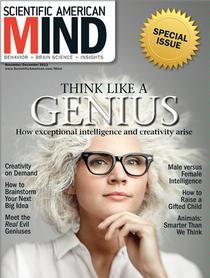 |
Switching on creativityOur 2013 Scientific American Mind Article shows how cases of savant syndrome have inspired an electrical brain stimulation technique for boosting creative insight. See http://www.nature.com/scientificamericanmind/journal/v23/n5/full/scientificamericanmind1112-58.html |
 |
Designing a “better” brain: insights from experts and savants.Normal cognition, while very efficient, develops cognitive mind sets. Breaking these mind sets can help explore new conceptual spaces, and thus be more creative. Our 2014 approach in the journal friontiers in Psychology is to temporally avoid mind sets by using raw perception instead, thus imitating aspects of the autistic mind. See: http://www.ncbi.nlm.nih.gov/pmc/articles/PMC4033246/ |
Todd Samson tries the Creativity Cap - Courtesy ABC from Redesign my brain |
|
Flash of fresh insight - Radio National |
|
Morgan Freeman - Through the Wormhole documentaryhttp://www.sciencechannel.com/tv-shows/through-the-wormhole/videos/creativity-cap.htm |
|
 |
"Brain stimulation enables the solution of an inherently difficult problem"Our paper in the May 2012 issue of Neuroscience Letters Certain problems are inherently difficult for the normal human mind but are solvable by unusual minds. From this observation, we discovered that an atypical protocol for non-invasive brain stimulation enabled the solution of such a problem(the famous 9 Dots problem). The article is the most downloaded in the journal from its appearance on line in April to the time of this entry in September. See http://www.sciencedirect.com/science/article/pii/S0304394012003618
|
 |
"The Perceptual Cues that Reshape Expert Reasoning" in the July 2012 issue of Nature Scientific Reports
|
 |
THE WALL STREET JOURNAL 6 April 2012
|
 |
Morgan Freeman's 'through the wormhole creativity cap' episode-25 July 2012http://science.discovery.com/videos/through-the-wormhole-creativity-cap.html
|
 |
Allan Snyder listed as one of 10 most creative people-in-higher-education-today-June 2012http://www.onlinecolleges.net/2012/06/20/the-10-most-creative-people-in-higher-education-today/
|
 |
Wired magazine features research from the Centre for the Mind-20 July 2012http://www.wired.com/wiredscience/2012/07/unlock-inner-savant/
|
 |
Switching on Creativity, Scientific American Mind. Special Issue: Genius(Nov/Dec 2012 p58-62)
|
New Website: http://www.creativitycap.com
|
|
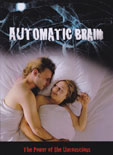
The Automatic Brain February 2012: The Centre's research features heavily in a new German documentary, The Automatic Brain, currently airing in France and Germany, and due to broadcast in Greece, Ireland, Cyrpus, Finland and Sweden. The documentary delves into the power of the unconscious mind and questions who's actually in charge, and asks whether anything we do is fully conscious. For more information, visit Automatic Brain (external site) |
Bigger, Better, Faster, More: Brain Doping September 2011: The Centre's research and its director, Professor Allan Snyder, appear in a new documentary currently appearing on Europe's Arte channel. The program looks at the Centre's research into facilitating insight and improving skills through non-invasive brain stimulation. |
110 Percent: Great Australian Sporting Speeches August 2011: Michael Winkler's new book, 110 Percent: Great Australian Sporting Speeches has just been released, and features Allan Snyder's 1998 Edwin Flack lecture to the Australian Olympic Committee.
|

The Centre's latest research generates international media coverage The Centre for the Mind's latest research, published in PLoS One on 3 February 2011, has attracted worldwide interest. Click here to link to a full list of articles about our research |
"'Thinking Cap' makes brainwaves in Australia" The Centre's latest research features in an article in the Sydney Morning Herald of 14 February 2011. Click here to read the article (external site). This article also appeared in The Age. |
"'Thinking Cap' makes brainwaves in Australia" The 10 February 2011 online edition of Australia's 7 News published a feature and interview with Allan Snyder on the Centre's latest research. Click here to read the article (external site). |

"Electrical brain stimulation boosts lateral thought" Cambridge University scientist, Dr Chris Smith, discusses the Centre's latest research on his BBC Radio show The Naked Scientists, on 6 February 2011. To read a transcript of his interview with Allan Snyder click here. To read his news article, click here. |
The Centre's research featured on ABC Radio National Breakfast Dr Chris Smith, from the BBC's The Naked Scientist, discusses the Centre for the Mind's "electric thinking cap" on ABC Radio National Breakfast on 4 February 2011. To listen to the interview on the Centre's YouTube page, click here. |

"Electric 'Thinking Cap' tested in Australia" The Centre's newest research featured on ABC's Good Morning America on 3 February 2011. To read the article, click here (external site). |

"Zapping the brain sparks bright ideas" A New Scientist article of 3 February 2011 discusses the results of the Centre's latest research. Click here to read the article (external site). |

"Zap to the brain 'helps solve puzzles'" The (UK) Telegraph of 3 February 2011 featured an article on the Centre's latest research. Click here to read the article (external site). |
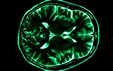
"Brain-zapping 'thinking cap' just might work" The Centre's latest research is the subject of an article on the USA's NBC network website of 2 February 2011. Click here to read the article (external site). |
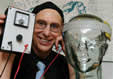
"Got a problem - put your electric thinking cap on" The Centre's latest research is the subject of an article in The Guardian of 2 February 2011. Allan Snyder features in an interview regarding the Centre's latest paper, published in PLoS One. Click here to read the article (external site). |
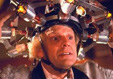
"How a zap to the brain could bring out the genius in you" A Daily Mail article of 2 February 2011 discusses the Centre's latest research paper published in PLoS One (see below). The article features an interview with Professor Allan Snyder, discussing his research. Click here to read the article (external site). |

"Facilitate insight by non-invasive brain stimulation" Our latest paper, published in PLoS One on 3 February 2011, investigates how our problem solving abilities can be improved with the application of transcranial direct current stimulation (tDCS) to the anterior temporal lobes. Click here to read the paper online. |
"Blind Tom, slave pianist sensation" The 22 January 2011 broadcast of Radio National's Into The Music focused on Blind Tom, a negro slave pianist who was a musical geniust. The program features commentary by Professor Allan Snyder. To read more, or to listen to the progam, click here (external site). |

"Are smartphones making us stupid?" This Sun Herald and Brisbane Times article of Sunday 21 November 2010 quotes Allan Snyder of the Centre for the Mind. Click here to read the article (external site). |

Visual memory improved by non-invasive brain stimulation Our latest paper, written in collaboration with Harvard Medical School, and published in Brain Research in September 2010, discusses how our visual memories are susceptible to errors, but are less so in people who have a more literal cognitive style. In this paper, we attempt to improve visual memory, and with the application of transcranial direct current stimulation, demonstrate a 110% improvement in visual memory in participants. To read the paper, click here (external site). |
Skull electrodes give memory a boost A New Scientist article of 13 August 2010 discusses the results of the Centre's latest paper (published in Brain Research). This research uses tDCS (transcranial direct current stimulation) to increase visual memory. Click here to read the New Scientist article. |
What Makes A Young Champion? Singapore 2010 On 7-8 August 2010, just prior to the first Youth Olympic Games in Singapore, the Centre for the Mind at the University of Sydney and it's partner the National University of Singapore, held the inaugural What Makes a Young Champion? forum. Opened by Singapore's Education Minister Dr Vivian Balakrishnan and featuring an introductory video by Prime Minister Lee, this youth-focused forum featured 11 young international champions who have demonstrated championship in many different fields. For more information, go to www.whatmakesayoungchampion.com |
Every chump can be a champ, 4 August 2010 In celebration of the Centre for the Mind's What Makes a Young Champion? forum to be held in Singapore on 7 and 8 August 2010, Professor Snyder is featured in a Straits Times full page article discussing the nature of championship and how our forum will seek to imbue young people with the seeds to nuture their championship potential. Click here to read the article. |
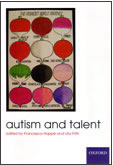
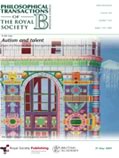
Autism and Talent This new publication by Uta Frith and Francesca Happé, the result of the Royal Society and British Academy's special meeting on Talent and Autism of September 2008, explores the connection between exception talent and autism. Professor Snyder's popular address to the Royal Society meeting features in the book. |
Conversations on Creativity with Allan Snyder An interview with Allan Snyder on creativity and savant skills, published on 13 January 2010, is featured on the Psychology Today blog Beautiful Minds, by Scott Barry Kaufman. Read the interview here (external site). |

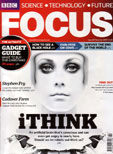
BBC Focus magazine November 2009 In it's November 2009 issue, BBC Focus magazine lists it's top five brain experiments. Featuring on the list is Centre for the Mind's research into savant skills, using transcranial magnetic stimulation to the brain's left anterior temporal lobe ("Magnets to the Mind"). |
Weird Connections: science series for the Discovery network Weird Connections is a series of half-hour programs about science made for the Discovery Network. Episode 21 "Monkey Genius" features the Centre for the Mind's research into savant skills and our experiments using transcranial magnetic stimulation. This episode is being screened on the UK's newest digital channel, Quest, throughout October 2009. For screening dates and times, click here (external site). |
Psychologie, (The Netherlands) July/August 2009 Professor Snyder's research into the autistic mind of savants is profiled in an article in the Dutch magazine Psychologie. Click here to read the article (untranslated). |
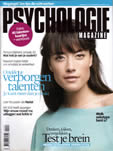
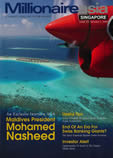
MillionaireAsia Singapore, Issue 17, Volume 5, 2009 MillionaireAsia Singapore magazine profiles the Professor Snyer's research into the nature of creativity and championship. In the article, Professor Snyder discusses his definition of championship and how, in his experience, a 'champion mindset' is crucial to success in any field. Click here to read the article. |
"A picture tells..." ABC1's Stateline Professor Allan Snyder is interviewed for an ABC1 Stateline story celebrating autistic art, which aired on 29 May 2009. To read a transcript of the story, click here. |

"Autism and extraordinary ability" The 16 April 2009 edition of The Economist discusses the research into the links between genius and autism in an article featuring the work of Professor Allan Snyder and the Centre for the Mind. Click here to read the online article |
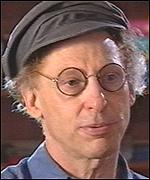
"Explaining and inducing savant skills: privileged access to lower level, less-processed information" Professor Snyder's paper, published in the 27 May 2009 issue of the Royal Society's Phil. Trans. R. Soc. B, hypothesises that savants have privileged access to lower level, less-processed information, before it is packaged into holistic concepts and meaningful labels. Owing to a failure in top-down inhibition, they can tap into information that exists in all of our brains, but is normally beyond conscious awareness. |
My Brilliant Brain The 3-part National Geographic documentary My Brilliant Brain, featuring Allan Snyder and the Centre in Part 3, Accidental Genius, is currently re-screening on Australia's National Geographic channel. First re-screening date is Sunday 29 March 2009. |
"Temporal lobe cortical eletrical stimulation during the encoding and retrieval phase reduces false memories" Our latest paper, published in PLoS One in
March 2009, in collaboration with the Harvard
Medical School, examines the consequences on a false memory task
of brain stimulation throughout the encoding and retrieval task
phases. |
"Another slice of pi" An article in The Guardian on Saturday 14 February 2009 discusses Daniel Tammet's new book Embracing the Wide Sky. The article quotes Professor Allan Snyder's comments on Daniel's savant abilities. Click here to read the article on The Guardian's website. |
"A semantic approach to the Creativity Quotient (CQ)" Our latest paper, published in the Creativity Research Journal, builds on our previous research (published in 2004) to discuss the ways in which creativity might be measured. Click here to read the article. |
"The incubation effect: Hatching a solution?" Numerous anecdotal accounts exist of an incubation period promoting creativity and problem solving. Our paper, published in the Creativity Research Journal, examines whether incubation is an empirically verifiable phenomenon and the possible role of nonconscious processing. Click here to read the paper. |
"A savvy savant finds his voice" The Weekend Australian of 31 January 2009 profiles the savant Daniel Tammet, who has just released his second book, Embracing the Wide Sky. The article quotes Professor Allan Snyder, who discusses Daniel's book and savant abilities. Click here to read the article. |
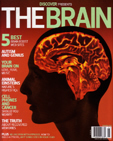
Discover magazine: The Brain Discover magazine's Winter (January) 2009 issue of The Brain features an article on the savant research of Professor Allan Snyder, titled "The Inner Savant."
|
Weird Connections: science series for Discovery's Science Channel Weird Connections is a series of half-hour programs about science made for Discovery's Science Channel. Episode 21 "Monkey Genius" features the Centre for the Mind's research into savant skills and our experiments using transcranial magnetic stimulation. This episode is being screened throughout January 2009. For more information, click here. For screening dates and times, click here. |
Daniel Tammet's new book: Embracing the Wide Sky Following his highly successful memoir Born on a Blue Day, renowned British savant Daniel Tammet has published his second book, Embracing the Wide Sky: A Tour Across the Horizons of the Mind. Chapter One discusses the brain and refers to Professor Allan Snyder's research into savant skills and the use of transcranial magnetic stimulation. The book was released in January 2009. For more information, click here to go to Daniel's blog. |
"Reducing false memories by magnetic pulse stimulation" Our research into reducing false memories through the use of transcranial magnetic stimulation has been published in the 16 January 2009 issue of Neuroscience Letters. Click
here to
read the article. |
ABC's The Science Show reports on Royal Society Talent
and Autism meeting To read a transcript of the show, featuring an
interview with Professor Allan Snyder, click
here. |
BBC
Focus magazine article
on the Centre's research Click here to read the article. |

Fragments
of Genius documentary shown on America's PBS Snyder discusses his controversial theory, developed in collaboration with colleague, Professor John Mitchell, on our extraordinary, inaccessible skills. He suggests that the skills can be turned on and off in people by sending magnetic pulses to the brain - a process called Transcranial Magnetic Stimulation. To read a BBC article about the documentary, click here. |
Professor Snyder interview for BBC World Service's Science in Action Following his Royal Society talk on 29 September 2008, the BBC World Service's Science in Action program aired an interview with Professor Snyder on his Thinking Cap research. |
"Australian Thinking Cap Could Unleash Our Hidden Genius" The Voice of America has profiled the Centre's research on the Thinking Cap in it's online article of 17 October 2008. Click here to read the article. |

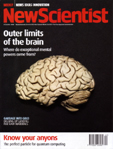
"Outer Limits of the Brain" - New Scientist cover story, 4 October 2008 Professor Snyder's theory on the extraordinary skills of savants is discussed in this New Scientist cover story. Click here to read the article. |
"Thinking Cap makes savants of us all" An article in the 2 October 2008 issue of The Australian discusses Professor Snyder's research into savant skills and a Thinking Cap. Click here to read the article. |
"Thinking cap that can unlock extraordinary skills being developed by scientists" Following his talk at the Royal Society, an article in the 30 September 2008 issue of The Telegraph, profiled Professor Snyder's research into a Thinking Cap. Click here to read the article. |

"The 'thinking cap' that could unlock your inner genius and boost creativity" London's Daily Mail of 30 September 2008 profiled Professor Snyder's research into the skills of autistic savants, following his successful talk at the Royal Society's Talent and Autism meeting in London. Click here to read the article. |
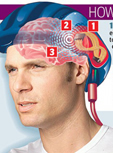
Talent and Autism - a joint Royal Society/British Academy conference Professor Allan Snyder presented an address at the Royal Society and British Academy's joint conference, Talent and Autism, held at the Royal Society on 29-30 September 2008. Professor Snyder's talk garnered significant publicity, leading to many media articles. Click here to see just a few. |
Oops, Wrong Planet ABC Radio's Science Show of 13 September 2008 played the soundtrack to Stephen Ramsey's film on Asperger's Syndrome, Oops, Wrong Planet. The film features Professor Allan Snyder and the Centre for the Mind's research into savant skills. To listen to the soundtrack of the film, or read the transcript, click here. |
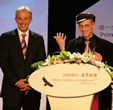
Tony Blair presented with What Makes A Champion? Distinguished Fellow Medal Professor Allan Snyder presented former British Prime Minister, Mr Tony Blair, with the Centre for the Mind's What Makes A Champion? Distinguished Fellow Medal on 4 August 2008, during the opening ceremony of the What Makes A Champion? forum in Beijing. Previous recipients of the Distinguished Fellow Medal are Nelson Mandela and Sir Richard Branson. |
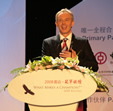
Tony Blair opens What Makes A Champion? forum in Beijing Former British Prime Minister, Mr Tony Blair, opened the Centre for the Mind's What Makes A Champion?forum held at Peking University on 4-5 August 2008, on the eve of the Beijing Olympic Games. The forum was designated an official Olympic Cultural Event. |
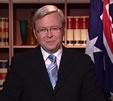
Prime Minister Kevin Rudd's video message to What Makes A Champion? 2008 Australian Prime Minister Kevin Rudd, in his opening remarks, welcomed the world to the Centre for the Mind's second What Makes A Champion? forum in Beijing. The Prime Minister also spoke briefly in Mandarin, exhorting the participants to "work hard and do not give up in the face of adversity." To view this video click here. |
What Makes A Champion? forum in Beijing The Centre for the Mind's second What Makes A Champion? forum took place in Beijing on 4-5 August 2008, in collaboration with Peking University. Champions from all fields of endeavour contributed to the forum, including Tony Blair, Henry Kissinger, Prime Minister Kevin Rudd, Kevan Gosper, Jackie Chan, Ian Thorpe, IOC President Jacques Rogge, Juan Antonio Samaranch, Oscar-winning composer Tan Dun, Lord Sebastian Coe and Nobel Prize winner Hao Weimin. |
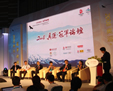
What Makes A Champion? 2008 gets global media coverage The Centre for the Mind's What Makes A Champion? forum received massive media coverage throughout China, including prime time television coverage. Check out just some of the media coverage on these links: Translated Chinese media (from Google) || Xinhua News || The Australian || News Limited photos || Good Global Games || Internet article || Internet article || |
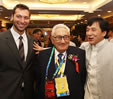
Allan Snyder meets with YouTube's Chad Hurley What Makes A Champion? 2008: Chad Hurley, the founder of the internet phenomenon YouTube, discusses what makes a champion with Professor Snyder in Beijing. |
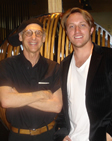
What Makes A Champion? student competition The Centre for the Mind ran a competition to give two University of Sydney students the opportunity to represent the University at the What Makes A Champion? Beijing 2008 forum. From a truly outstanding field, the two candidates chosen were Bianca Cooper and Lukasz Swiatek. |
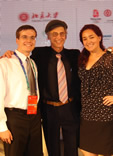
Oliver Sacks visits Sydney 13 August 2008: Oliver Sacks visited Professor Snyder for wide-ranging discussions about the mind. |
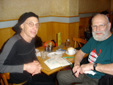
What Makes A Champion? sponsorship signing ceremony Professor Allan Snyder spoke at a media conference 16 July 2008, on the occasion of the ceremony to mark the Bank of China's sponsorship of the second What Makes A Champion? forum at the Beijing 2008 Olympic Games. The second sponsor of the What Makes A Champion? 2008 forum is Lenovo. |
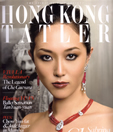
"Savant Garde" Hong Kong Tatler published a profile of Professor Allan Snyder in its June 2008 issue. Click here to read the article. |
What Makes A Champion! book launch Professor Snyder's book What Makes A Champion! is now available in Chinese (published by Peking University Press) and includes a forward written by the President of the prestigious Peking University. The gala book launch took place in Beijing on 9 April 2008. The occasion of the book launch also marked the start of Peking University's What Makes A Champion?program. |

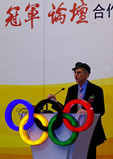
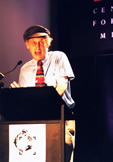
Professor Snyder gives keynote address at Peking University Professor Snyder gave the first address in the distinguished What Makes A Champion? Lecture Series at Beijing's Peking University on 9 April 2008. The lecture, entitled What Makes A Champion?, was a prelude to the Centre's second What Makes A Champion?TM forum, to be held at Peking University on 4-5 August 2008, on the eve of the Beijing Olympic Games. |
What Makes A Champion?TM What Makes A Champion?TM has been designated an official Olympic Cultural Event for Beijing 2008. The What Makes A Champion?TM forum will be held at China's most prestigious university, Peking University, on the eve of the Beijing Olympic Games. It will examine how culture modulates our understanding of and attitudes to extraordinary success. Professor Snyder is the creator of What Makes A Champion?TM. For more information, go to the WMC website. |
"Are animals autistic?" An article published in the February 2008 issue of PLoS Biology discusses whether animals are autistic. This co-authored paper is the result of the FEAST workshop on Higher Cognition in Animals (May 2007). Click here to read the article. New Scientist discussed the paper in an article in its 23 February 2008 issue. Click here to read the article. |
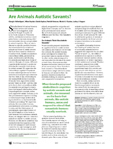
"Champion mindset of the drop-out geniuses" The 2 February 2008 issue of the South China Morning Post features an interview with Professor Allan Snyder, discussing his research into championship and the Champion Mindset. Click here to read the article. |

| Interview with
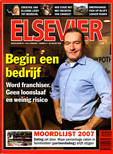
Allan Snyder featured in Elsevier magazine
The Dutch weekly magazine Elsevier, featured an interview and profile of Professor Allan Snyder in its 26 January 2008 issue. In the article, Professor Snyder discusses his research into autistic savants. To read the article (untranslated) click here. |
My Brilliant Brain The 3-part National Geographic documentary My Brilliant Brain, featuring Allan Snyder and the Centre in Part 3, Accidental Genius, is currently re-screening on Australia's National Geographic channel. Screening dates are 18 and 25 January 2008. |
"Mind Matters" Malaysia's national The Star newspaper of 25 November 2007 features a profile of Allan Snyder. This follows the airing of the National Geographic documentary My Brilliant Brain on Malaysian televsion. Click here to read the article. |
My Brilliant Brain The 3-part National Geographic documentary My Brilliant Brain, featuring Allan Snyder and the Centre in Part 3, Accidental Genius, is currently screening on Australia's National Geographic channel. Screening dates are 16, 18, 20 and 24 November 2007. |
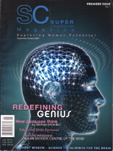
Interview with Allan Snyder featured in new SuperConsciousness magazine The premier issue of SuperConsciousness magazine (September/October 2007) features an interview with Allan Snyder, discussing the concept of genius. Click here to read the article.
|
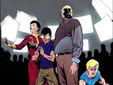
The Real Superhumans This Canadian documentary tells the stories of real people with extraordinary 'superpowers'. Screened by Discovery Channel worldwide, the program features Allan Snyder with Ruediger Gamm - called the Human Calculator. Click here to view the airdates throughout Europe and East Africa. Here is an extract of the documentary on YouTube. |
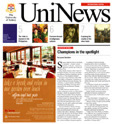
"Champions in the Spotlight" The University of Sydney's UniNews 5 October 2007 edition features an interview with Allan Snyder. The article discusses the Professor's research into championship, which will be highlighted at the second What Makes A Champion? forum, to be held at Peking University just prior to the Olympic Games opening ceremony. |
|
"Beautiful Minds" The Weekend Australian Magazine of 11-12 August 2007 features an article on the Tao brothers, a trio of highly gifted young men. In the article, Allan Snyder discusses his research into the nature of genius in relation to Terry, Trevor and Nigel Tao. Click here to read the article. |

|
A Beautiful Mind The 12 August 2007 edition of Channel Nine's 60 Minutes featured a story on the mental abilities of autistic savants, highlighting the extraordinary Daniel Tammet and Stephen Wiltshire, drawing on the research of Allan Snyder and the Centre for the Mind. |

|
"How does a human calculator do it?" A BBC News Magazine online article of 30 July 2007 quotes Allan Snyder in its discussion on the abilities of autistic savants - particularly the human calculator, Alexis Lemaire. Click here to read the article. |

|
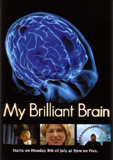
My Brilliant Brain The Centre's research features in a 3-part UK documentary My Brilliant Brain, made by National Geographic and screened on the UK's Channel Five on 23 July 2007. Allan Snyder and the Centre feature in Part 3, which discusses the notion of 'accidental genius'. Click here to read Channel Five's blog page about the documentary. Click here to read The Times online review of the documentary. |
|
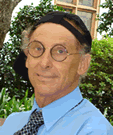
"Patching up the ivory towers" Allan Snyder's work was singled out in article in the Sydney Morning Herald on 12 May 2007 as the type of funding that University research will get in the future. The article emphasises that "the best universities are keen to ensure the money is used to reward excellence." Click here to read the article. |
|
Are animals autistic? Creativity, Mindsets and Autism. On Sunday 6 May 2007, Professor Snyder presented a keynote address at the elite, international Forum for European-Australian Science and Technology Cooperation (FEAST) workshop on Higher Cognition in Animals. |

|
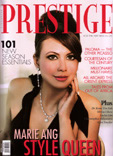
"Championing Creativity" The April 2007 edition of Singapore's Prestige magazine features an article on Professor Snyder's research into creativity and the Champion Mindset. Click here to read the article. |
|
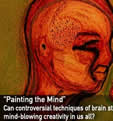
Painting the Mind Professor Snyder's research on the creative potential of the brain is featured in a UK Channel Four documentary, Painting the Mind, which screened on ABC's Four Corners on 23 April 2007. Click here for more information. Painting the Mind has also been screened in Scandinavia and is awaiting screening in the UK. |
|
Comment on Priming Skills of Autistic Twins In a letter to the editor of the Journal of Autism and Developmental Disorders (published online on March 2007), Professor Snyder responds to a previously published letter regarding the priming skills of autistic twins in Oliver Sacks' research. Click here to read Professor Snyder's comments. |
|
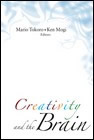
Creativity and the Brain Creativity and the Brain is a new publication edited by Mario Tokoro and Ken Mogi, described as "a modern primer on the science of creativity". It features a chapter by Allan Snyder, titled 'The Genius Within'. The book is available at www.worldscibooks.com |
|
Swiss newspaper features article on Allan Snyder The Swiss daily newspaper Tages-Anzeiger of 19 March 2007 featured Allan Snyder's research in an article on the skills of autistic savants. Click here to read the article (untranslated). |
|
"Talent, and time to give, the mark of a champion" In an opinion piece in The Australian on 20 January 2007, Professor Snyder discusses the mindset of champions. Click here to read the article. |
|
Think You're Smart? The Science Museum of London features the Centre in its new
exhibition on |
|
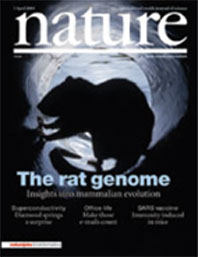
Nature piece on "Autistic genius" The 1 April 2004 edition of Nature features a piece by Professor Allan Snyder entitled Autistic Genius?. Professor Snyder discusses the possibility of there being two distinctly different cognitive strategies leading to creativity: normal and autistic. One strategy is conceptual, the other literal. |
|
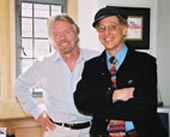
Sir Richard Branson awarded Distinguished Fellow Medal Sir Richard Branson is the recipient of the 2003 Distinguished Fellow Medal of the Centre for the Mind. Sir Richard, adventurer and corporate champion, spoke on "creativity and championship". The event was held in the Great Hall of the University of Sydney and was featured on news programs via all television networks, radio and the popular press. Click here for more information about the event, including a transcript of Sir Richard's speech. |
|
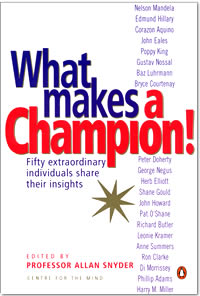
What Makes a Champion! Book The What Makes a Champion! Penguin Book is now available online. Hear Fifty extraordinary individuals share their insights on championship. The What Makes a Champion! event was opened by Nelson Mandela on the eve of the Sydney 2000 Olympic Games. Click here to find out more. To read more about the What Makes a Champion! event visit: www.whatmakesachampion.com |
|
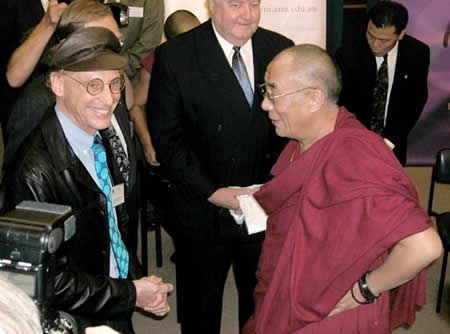
Dalai Lama Mind and Science Forum Professor Snyder gave the keynote address at the unique Dalai Lama Mind and Science Forum held in Canberra on 23 May 2002. Click on the photo at left for more information. |
|
What Makes a Champion Event Nelson Mandela led champions from all walks of life at our unique event What makes a Champion? on the eve of the Sydney 2000 Olympic Games. Our intellectual Partners were AMP and Ernst & Young. McKinsey and Company have recently joined with us for our newest initiative What makes a corporate champion? For more information on the What Makes a Champion? event, click on the graphic at left. |

|
|